
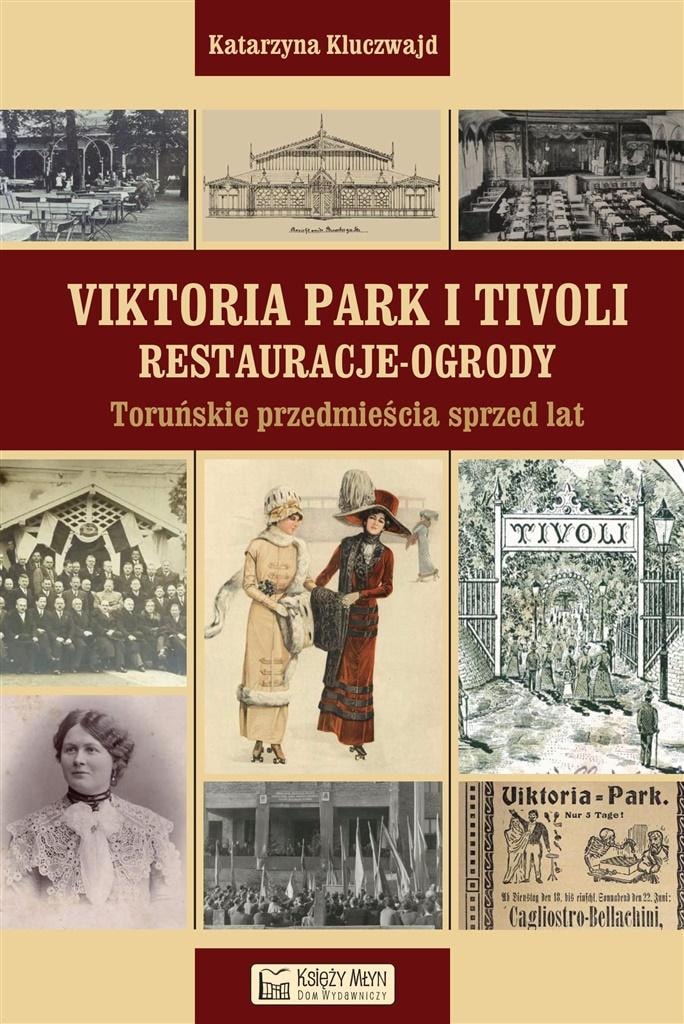
KATARZYNA KLUCZWAJD VIKTORIA PARK AND TIVOLI RESTAURANT GARDENS
Travel back in time to Toruń at the end of the 19th century and discover the fascinating history of popular culture that flourished in the suburban salons of Viktoria Park and Tivoli. This book is a journey through the history of places and people, architecture and its transformations, owners and managers, artists and consumers. Discover the stories of the existence of buildings and unforgettable events that together create a colorful picture of Toruń's culture from years ago.
- Discover the history of Toruń's culture through the prism of popular salons.
- Learn about the history of Viktoria Park, known as the Artus Court of the middle class.
- Find out about the activities of the theater and opera scene in Viktoria Park.
- Follow the fate of the Pomeranian Film Factory Marwin-Film.
- Immerse yourself in the atmosphere of events of German religious associations in Tivoli.
- Discover the secrets of the Roller Skating Palace and the Rose Festival.
- Learn about the history of the third theater scene in Toruń during the Nazi occupation.
In her book Suburban Salons Restaurant Gardens: Viktoria Park and Tivoli, Katarzyna Kluczwajd shows the history of the city's culture in general and popular culture from the end of the 19th century to 1939, with an emphasis on the lesser-known period before 1920. It is a story of places that witnessed important events and meetings, of people who created and visited them, and of architecture that has stood the test of time.
Viktoria Park, called the Artus Court of the middle class, was a place where theater and opera scenes, varits, operated. There was a Dance Palace, performances by stars and film screenings. Wrestling tournaments, lectures, rallies, association events, celebrations of national holidays and great anniversaries were organized. The avant-garde theatrical spectacle King Oedipus (1912), the first performance of Adam Mickiewicz's Dziady (1913) in Toruń, the Polish Industrial Exhibition (1913) all under the rule of Joanna Łyskowska were of great supra-local importance. After 1920, Viktoria Park gained fame thanks to the Pomeranian Film Factory Marwin-Film (19291930). After the fall of the restaurant garden, the continuation of the place's history is the construction of the building of the Court of Appeal (1938-1947), described only in this monograph.
Tivoli, in turn, specialized in events of German religious associations and concerts of music, including serious music (including Richard Wagner). The place was known for the Roller Skating Palace (1911), the beer festival, garden exhibitions, the Rose Festival, the annual Reformation Festival, lectures. After 1920, Tivoli gained the rank of a shrine of the X Muse, in the period of Nazi occupation, the third theater scene in the city.
Katarzyna Kluczwajd's book is not only a fascinating read, but also a mobilization to care for memory and shape a sense of connection with the place. It contains many new findings and unpublished illustrations that allow you to better understand the history of Toruń and its inhabitants. It is a must-read for all lovers of history, culture and architecture.
CARUNO-2025-12-17-19:27:04 cuSpecifications
| Author | Katarzyna Kluczwajd |
| Publisher | Księży Młyn Dom Wydawniczy |
| ISBN | 9788377296387 |
| Binding | twarda |
| Number of pages | 264 |
| Format | 297x216 mm |
| Year of publication | 2021 |
Katarzyna Kluczwajd Viktoria Park and Tivoli Restaurant Gardens
Gross price, incl. VAT
Shipping costs:
 Produkt polski
EAN: 9788377296387